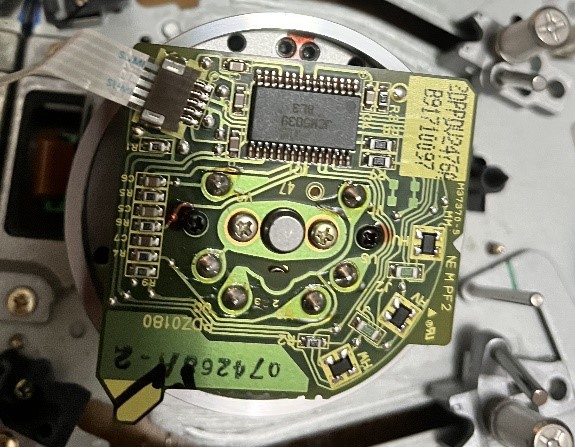
On February 6th, Tim Simmons gave us an enlightening talk on electronic “wafer” circuit boards which are the basis of all electronic devices. Through history components have reduced in size. The first dramatic reduction was when the transistor replaced the glass enveloped thermionic valve in the 1940s. Modern integrated circuits, which can be found in the latest mobile phones, contain the equivalent up to 20 million transistors in an area of less than 2 square inches. Moore`s law was quoted suggesting that capacity has been doubling every two years. These integrated circuits also known as chips are produced using photolithography and are etched onto 12” or 6” thin wafers cut from a large crystal of silicon. This will be doped by adding boron or phosphorous to give the semiconductor property required. The wafer which is divided up into small pieces each will contain the integrated circuit.
The sophisticated machines for carrying out this process out are only manufactured by one company in the world: ASML based at Eindhoven in the Netherlands. The most important chip maker is in Taiwan. Described as the most powerful company in the world, TSMC is sought after by China and the US. The wavelength of the UV light used to etch the circuits has reduced from 436nm down to 3nm. Further reductions may be possible using free electron lasers. The shorter the wavelength the greater the density of circuitry which can be applied to a given area of the chip.